AI-Supported Monitoring of Peatland Agriculture (KIMoPa)
Determining vegetation heterogeneity in rewetted peatlands to optimize management for the sustainable use of biomass in the agricultural value chain
Background:
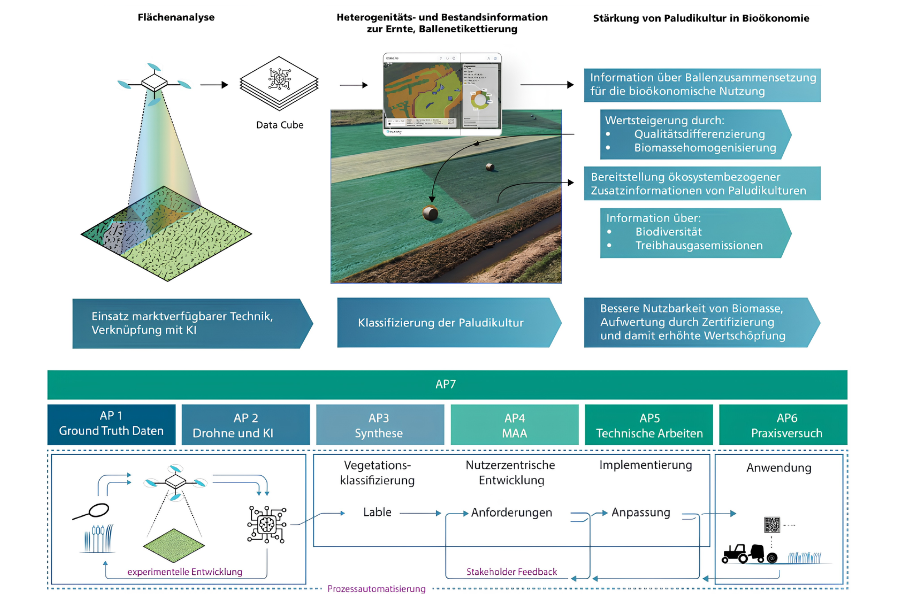
The KIMoPa project is developing innovative AI technologies for the detection and classification of bog vegetation and investigating their practical application in agricultural value chains. The goal is to make the management of paludiculture areas—that is, the agricultural use of wet and rewetted peatlands—more efficient and economically viable.
To date, the heterogeneous vegetation composition of peatlands, consisting of sedges, rushes, cattails, reeds, and other plants typical, has posed a challenge for agricultural practice and material utilization.
KIMoPa addresses this gap: Using drones and artificial intelligence, we generate detailed vegetation maps that enable an objective assessment of the areas—ranging from the occurrence and distribution of individual plant species to the estimation of biomass quality and greenhouse gas potential. Agricultural businesses use this information to adapt their processes and management practices or to utilize the biomass specifically for various applications.
Project Objectives:
- AI-supported vegetation recognition: Development of machine learning models for the automatic identification and classification of bog and paludified crops using drone data
- Digital monitoring platform: Development of an end-to-end solution for use in the field, including interactive visualization of vegetation heterogeneity and management information
- Pilot study on bale labeling: Field testing of the assignment of biomass composition to harvested bales for quality-based marketing
- Practical applicability: Involvement of stakeholders in practical development, investigation of integration potential, and economic feasibility assessment
Title:
KIMoPa - AI-Supported Monitoring of Paludiculture
Funded by:
Federal Ministry of Agriculture, Food, and Home Affairs (BMLEH), Agency for Renewable Resources (FNR), Project No. 2225MT005B
Duration:
May 1st, 2026, to April 30th, 2028
Project Leader at the University of Greifswald and WP1:
Lead of subprojects WP 4 and WP 6:
Subproject researchers:
Project partners:
- University of Greifswald, Institute of Botany and Landscape Ecology
- Fraunhofer Institute for Computer Graphics Research (IGD) (AP 2, 3, 5, and 7)
Funded by:
Collaborating partners: